Statement of Intent

This is Old Fools outlet for kilts and other unbifurcated garments for men or women. It is not for furthering cross dressing or costuming. It is for the furthering of alternate apparel for men and sometimes will discuss bifurcated (trousers, pants, etc.) garments as well. Since women can and do wear anything they want little will be said about womens clothing. That is not to say that nothing will be said about them. If men want to dress and look like a woman that is fine with me and some do it very well. Here, however, the intent is about men that want alternate mens clothing. The Old Fool (me) is not an expert in this field but he sews, has made several kilts, modified store bought kilts and wears them. I also wear sarongs, pareu, lava lava and anything else that is comfortable and practical. Some of my kilts might be called skirts but I am comfortable with that.

Visit the Old Fools blog

So I said to the boys "hello girls".
"We're not girls" they replied.
I said "you're dressed like girls".
They immediately pointed out that I was the one wearing a skirt. I had on a kilt.
I then asked "when was the last time you saw a female in anything but pants?"
Silence.

Friday, May 13, 2011

Old Fools Kilts: Ironing pleats

If the world were a logical place, men would ride side saddle. 
 ~Rita Mae Brown

Ironing is so out of style these days that when I bring it up I am sometimes treated as if I have suddenly sprouted another head.  Eyes glaze over, especially the females, and men snicker. Children have no idea what I am talking about.  I happen to like to do it. It is a mindless thing that accomplishes something while my mind is free to wander about on it's own.

The picture above is of a wool kilt that I made and it does not need ironing often but I had just moved a Velcro closure strip because my waist has gone down two inches since I made it.  I'll tell about this kilt in another post.

I hadn't intended to do this job at this time but SWMBO (she who must be obeyed) had a pair of pants that needed hemming so I had the irons out anyway.  When I set up the sewing machine I automatically set up the ironing board. Having it handy makes sewing so much easier.

The reason for two irons is so I have a cold iron for drawing heat out of a pleat I have just steamed. That helps to set it.  The white steam iron on the right is very light and does a good job of steaming.  The iron on the kilt is twenty years old or more as it still has a cloth wrapped cord. I works fine but I bought it for it's weight (thrift store one dollar).  It weighs more than double the new iron.  For years I have looked for a cast iron type that is set on the stove to heat but every time I find one it is an antique and to costly for me. Mostly those end up as doorstops or bookends I think.

The technique I use is to set it on a pleat just ironed while ironing the next.  This iron will cover two pleats.  It may sound tedious but the results are worth it.

Tuesday, May 3, 2011

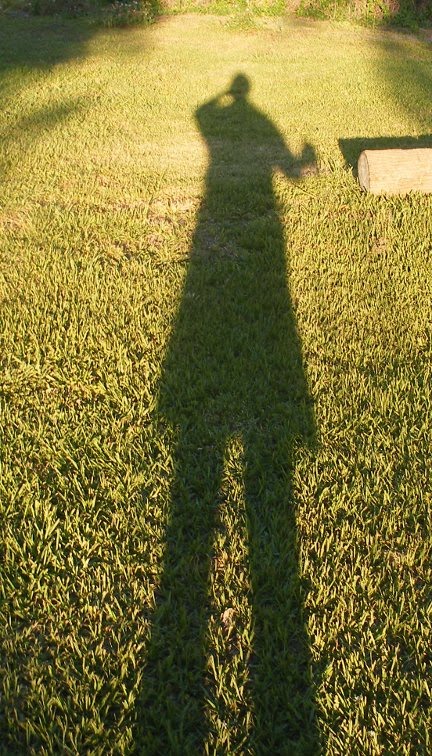
Old Fools Kilts: My Kilted Shadow

What is life? It is the flash of a firefly in the night. It is the breath of
a buffalo in the wintertime. It is the little shadow which runs across the
grassand loses itself in the sunset..
Blackfoot proverb


With wine glass in one hand and camera in the other I'm off to a sunny corner of the garden for sunset cocktails with my bride and the kittens.

Thursday, April 28, 2011

Old Fools Kilts: A Summer Kilt For the Garden and Shop

Is there anything worn under the kilt? No, it's all in perfect working order -Spike Milligan


This is another kilt construction that was driven by the fabric. I happened on
to this polyester fabric somewhere and I cannot for the life of me remember
where. My penny pinching gene however remembers that it was one dollar a yard.
I can't buy shop rags for that so I could not pass it up.

It is very light camo polyester. It is so light that if you hold it up to the
light you can see right through. That's just right since in a minimum kilt
there will be three layers in back and two in front. I am not the authority on
what is minimum but that is my minimum. I have figured out how to make a kilt
like garment that has less since making this one and still look like a kilt but
that will come later in a Kilted Towel Post.
Front
In the not so good photo above of the front you can see the apron is not full
width. It is about 1/3 my waist measurement.  Contemporary kilts seem to go for
something around that number some are more narrow but this is what I liked best. It makes the pleats show from the front and makes for less interference of the cargo pockets with the pleats.

In the photo below the reverse box pleat is in the center. All the pleats are sewn down three inches from the bottom of the waistband. The outer edge of each pleat is sewn in as well but not the inner edge. That was not necessary with this fabric but I was having so much fun with the machine I couldn't stop myself. (I have resisted buying a nail gun because of that sort of compulsive excess.) It does make it truly wash and wear. I can take it out of the dryer, shake it out and wear it.
Tail Feathers
I made this kilt before I started losing my waistline. I had lost weight but my waist measurement did not show it yet. Once you get a gut it is damned hard to get rid of. Now I have lost enough that it is on the verge of getting lopsided. Oh well I made it and I can adjust it and gladly.


This photo taken in September 2009 was taken in the garden mainly to show one of the walking sticks I made from the fallen gifts from the trees caused by hurricane Gustav. It does show the length just below the top of the knee cap and the cargo pocket on my right side.


Damned long-haired hippy freak

This is the kind of work that this light weight kilt was made for. If you look close you can see the left side cargo pocket. I was cutting tin for the roof of the generator lean too and it was hot out. Even as lightweight as this kilt is it's still plenty hot. I am working on a design that vents better. The ideal would be to take it off when it gets that hot but then there would be visits by the authorities protecting innocent eyes from that spectacle and the paperwork just wouldn't be worth it. I will admit to having done that inside the shop when it was 95 degrees squared (meaning the humidity equals the temperature). 
The camo pattern hardly shows blood.

Saturday, April 23, 2011

Old Fools Kilts: My First Serious Attempt At Sewing A Kinggussie Kilt

One American dollar per yard for 10 ounce acrylic .
What a deal. If it looks brown that is because it is.
Unlike the shirting flannel in my first DIY kilt attempt this full width fabic was long enough to make a kilt for me without piecing it together.  It takes less than 4 yards of material in overall length to make an acceptable kilt for me.  Since all kilts are layered garments it became apparent to me that I needed to choose the fabric wisely.  A traditional eight yard kilt would only be wearable at most three months of the year. Some years would never be cool enough.  Nice to have and they look great but impractical for SE Louisiana.  So I went about figuring out the minimum layers I could make one  with and still have all the good characteristics of a kilt.

What I finally boiled it down to was two layers in the front consisting of the inner and outer apron and pleated in the back with no pleat overlapping another.  That means that when hanging at rest there are three layers. but when the pleats are opened it is one layer.
I wanted a casual contemporary kilt and I thought I was being smart when I decided to make it a reverse kingussie which is pleated symmetrically from the front to center of the back. The pleats point back and end in the center with a reverse box pleat. Little did I know what a pain in the ass this would be. It has to be carefully planned so that the front apron and the center pleat in the back are centered.  You cannot just wrap it further around your waist as you lose weight because the centering will be off but since I built it I can unbuild it for modification when necessary.

Hidden pocket 
Making a kilt for me is relatively easy as I have perfect measurements 41-41-41. I still have to taper the waist smaller than the hips but not much. The photo above is of the nearly finished kilt showing the opened hidden pocket.  I would have used the selvedge for the hem but it was trashed in several areas. That may have been the reason for the one dollar a yard price.

Instead of the traditional full apron I made
 a one third apron. 


The cargo pockets blend in nicely.
I did not get the kilt centered


Left side


I have lost two inches in the waist and the kilt is starting to get a little lopsided when I wear it. It will soon be time for a make over.  When I do I will make the cargo pockets of equal size.  They were an experiment that became essential.  When they are loaded down the do tend to foul the pleats somewhat.

This is a very comfortable kilt and just feels right when I wear it which is often.  It is wash and wear so I'm not reluctant to wear it in the garden. Machine washable, dryer rugged and put it on.  I usually touch up the pleats with a steam iron but it is not necessary.

This belt was the original closure but it was such a pain that as a
buckle that I changed it to slipping through the buckle ring and
fasten with Velcro.  The under apron is fastened with Velcro.

Tuesday, April 19, 2011

Old Fools Kilts: Oh How I Love Pockets

Sporrans
Purses, sporrans*, backpacks, handbags, shoulder bags, dirtbags, butt bags and paper sacks are used to carry your stuff. I have used them all but there is nothing like a pocket for the small stuff.  For instance, I carry a pocket knife all the time except when I sleep or shower.  It is, like fingernails, a primary tool and I use it multiple times daily.  If I could have one of my fingers modified to be a jackknife I would certainly look into it.  One of the big problems with the nudist camp is there was no place for my pocket knife or for money for the snack (beer) bar. There was a girl there that just stuck her folding money in the crack of her butt and I suppose I could have done that with my jackknife but I never could make that work for me. She had quite a butt. Sorry no pictures.


* Since the traditional kilt does not have pockets, the sporran serves as a wallet and container for any other necessary personal items. It is essentially a survival of the common European medieval belt-pouch, superseded elsewhere as clothing came to have pockets, but continuing in the Scottish Highlands because of the lack of these accessories in traditional dress. -from Widipedia
This carried over into America with trailblazers calling their sporran a "possibles bag".  -from me
Traditional kilts have no pockets.  The great kilts have bags and folds so I imagine some of those took care of small items.  The baggy leine sleeves probably took care of having  pockets as well. I don't have baggy sleeves and my kilts range from casual to contemporary. Some have pockets and those I have made have added pockets but two of my favorites are casual kilts sold by Stillwater Kilts of Minnesota and they do not.  These are inexpensive lightweight acrylic made in the traditional style. The kilt featured in the first post of this blog is an example. It is a comfortable kilt and easy to care for but has no pockets. I aim to fix that.
I had these pant legs that I cut off last winter when I converted some black khaki pants (BugleBoy) into knickers. SWMBO (she who must be obeyed) likes knickers about the same as she does kilts. Which means she does not. It's not that she does not like them it is that she is embarrassed when I wear them for some reason known only to her. It seems that many wives think kilts (and knickers) are OK on someone else's husband but not hers.  More on that in a later post. Knickers are great for bike riding in the winter and I will post about the making of the knickers (simple) in a later post as well but meanwhile back to kilt pockets.
Sorry about the black on black but if you look closely you see how I did it.
They happened to be the size I wanted so all I had to do was sew the bottom closed, turn down the top to the Levi type pocket I wanted and sew the remainder of the top closed. This could easily have been done by hand but in this case I used my machine.
Pant legs are asymmetrical as one side is bigger than the other. The smaller side should be in so that it still lies flat when loaded with stuff.


Turning the apron back I then safety pinned the pocket to the very bottom of the waist band so that the load would be carried by the waist band. I tried it and made a few adjustments to the position before sewing it on. The reason for the safety pins is I wanted to overloaded the pockets to see if this was really going to work. Pockets always get overloaded sooner or later and I do not want surprises later.
These pockets are large but that was not to make them carry more stuff but so the stuff could be spread out and not bulk up.

After the final sewing and some ironing the front apron covers the pocket. With the amount of belly fat that I presently have the kilt hangs properly and there is no evidence that there is a pocket there full of money (I wish). It is as easily accessed as any pants pocket.

I do not know how it will look when/if I lose this belly fat but since I only lose about 30 grams a month that is not an immediate problem.

George Carlin pointed out that everybody else's possessions are called shit as in "their shit" but yours is stuff as in "my stuff".  I have way too much stuff which is really shit.

Sunday, April 17, 2011

Old Fools Kilts: Grodie Goose Kilt or Re-purposing military uniforms into something useful

I wrote this to the xmarks the scot forum about the Grody Goose kilt I found on Ebay in June of 2008. It was my first kilt purchase. They are made and sold by people that make them from surplus BDU's (battle dress uniform). As far as I am concerned this is in the spirit of "beating swords into plowshares". A concept I particularly like. It would be nice if their source of material dried up but that will never happen. There has always been war and there will always be war until the last man standing declares himself the winner and dies. Then there will be no more war.

June 1, 2008
I have been wearing one of these almost daily for the last three weeks while gardening and working in my shop. I have found it to be very satisfactory for that. Mine has a label that says “Coat, Hot Weather”, “woodland camouflage” and “battle pattern” plus washing instructions. It had a bunch of insignias with it that were air force and I found a dog tag in a pocket that is also air force. It was well broken in therefore soft and comfortable. Washing has been a snap. Throw it in the wash then the drier put it on and go back to work.

Front – button closure

Whether it's a kilt or not depends on how fussy you are. I ain't fussy. If it's a skirt made for a man and has pleats in the back it's a kilt. My 15 year old grandson and his friends recognized it as a kilt. The closure is buttons in the front a little to the right of center. Pockets button and all buttons are hidden.


Back with one of the pleats turned back

Mine is pleated in the inverted Kingussie style (I believe that's what it's called). In any event it has four wide pleats either side of a inverted box pleat all pointing to the back. That is nice in the garden and the shop as it doesn't snag on things. It is very full, free and comfortable. It is definitely contemporary and casual. It is as formal as a man that only wears shoes and socks in the dead of winter and hasn't owned a tie since the early eighties needs. Come to think of it I haven't seen my shoes since winter before last. Washed and touched up with steam iron and this kilt can go anywhere a Utilikilt can.

Delivery time was a little over a week and when I inquired by email I got a prompt reply. Very satisfactory. I asked for a 19 inch length and that's what I got. My only complaint is the hem in the back was not even. The pleats on either side of the center box pleat were 1 ½ to 2 inches longer that the center or the front. I corrected that myself.
This last picture is of a belt loop. It is very rough and barely wide enough for a 1 3/8 belt. For the money I'm not complaining. It is not a slick and polished garment but it suits a man that's not slick and polished.

Here it is nearly three years later and I still wear this thing. Somwhow it just seems the right thing to wear in the shop or garden. It really is too hot when the temperature and humidity really get up there but other than that no complaints. I have since made another much lighter wash and wear kilt in camo for really hot weather. More on that one later.


The panel to the far right is the addition of the under apron

I did make some changes since then. I've lost a bit of weight and so I have disassembled the waist band somewhat and taken it in. The trouble with a kingussie is that unlike knife pleats that you can just wrap around further as you lose weight a kingussie needs to be centered in the back. After losing an inch or two it's rip those seams out time. I did that and sewed down some pleats while I was at it. I redid the belt loops and in general just made it fit better.


I also added an under apron (see right side of photo above). The white patch is Velcro.  Now I only button the top two buttons and it wears like a regular kilt. It makes it a lot easier to sit or squat with some decorum.

This thing is durable in fact it is practically bulletproof. I can see why the military uses it. My only complaint is that it is extremely hot. This fabric does not breath at all. I actually had to rig a fan on the floor to blow up my alley last summer while working on bikes. Iraq in summer in this stuff has to be a bit of hell.  I like the pockets. It beats having to wear an apron. 

Saturday, April 9, 2011

Old Fools Kilts: The Leine

The image below is from the Sewingcentral.com website. The description is from there as well. Unfortunately they are out of stock.

Alter Years PAY015 "Irish" Leine (Shirt)
With this pattern you can make several different styles of the traditional Irish shirt called a leine (pronounced "linn") worn by both men and women. The shirt is very large and loose and has full, bagged sleeves gathered at the shoulder and down the arm on a drawstring or with its sleeve gathers stitched in place with stitches or decorative trim. There are diamond shaped gussets under the arm for ease.
Two different sleeves are given - rectangular or triangular - and two necklines - scooped or slit front. While both necklines and sleeve styles are seen on both men and women, for women the leine commonly is styled with the scoop neckline and large rectangular bag sleeves. The leine is usually worn under the Irish dress (PAY014).
For men, the neckline is often higher with the slit front opening, and frequently the sleeves are the somewhat smaller triangular bagged style. A long leine could be belted and worn alone, or with an ionar (a type of short doublet). In modern Renaissance festival tradition, men also wear leines with great kilts.
This is a very loose fitting garment and some people prefer their leine looser than others. Choose the appropriate cutting line by comparing your bust/chest measurements to the size chart. If you like a lot of room in your shirts, choose the next size up.
The pattern includes sizes from a 32 inch chest through a 52 inch chest.


Leine is the Gaelic word for "shirt". It doesn't actually refer to any particular kind – it is (and was) used for any sort of shirt. I have heard Leine is pronounced as shown above but also as, very roughly, LANE-yeh, where LANE is like the English word "lane" and the y is like in the English word "yes".

This is what men women in cold climates wore in one form or another until recent history (several hundred years). Probably the first were of animal skins later, as textiles became available, were made of clothe. They were made long, short, fancy and plain. They became dresses or robes but basically they were a leine. They are basically the same as tunics which have been worn since the cave folk made them from animal skins. To most Americans, who mostly think history started 10 years ago, it's a dress. The baggy sleeves were used as pockets.

A leine can be worn stand alone, over other clothing or under other clothing. The long tee shirts that you see many young men wearing these days is basically a leine. The below the knee over-sized baggy shorts that young men wear are made to look like a skirt. Google "Leine" to "traditional Irish clothing and you'll find lots of information about this garment.

Near as I can tell it was and is unisex and common in medieval times. Personally I like the more modern versions. Long tee shirts and long collared shirts are quit comfortable for laying about the house and garden not that anybody does that these days. When you work 70 to 100 hours a week there is not much laying about. When I say I am going to change into something more comfortable I am probably going to change into one of my oversized knee length tee shirts. Instead of building up the fire when it gets cold I add a kilt and/or wool knee socks. Simple comfortable clothes for a simple man.

Examples of ancient Irish kilts are usually a belted leine.